
By Eric de Place and Julia Stone
Beaver County is a real-time case study in the local economic impacts of petrochemical development.
It’s been nearly five years since Shell’s massive ethane cracker launched operations near Monaca in Beaver County, Pennsylvania. The chemical-to-plastics plant was once touted by boosters as a “renaissance” for the region’s economy, but those promises have utterly failed to materialize.
The latest federal economic data show unequivocally that Beaver County is falling behind the nation, the state, and its neighboring counties by nearly every measure of performance. In fact, after Shell announced plans to build in 2012, the county seems to have gone into an economic slide with absolute declines in GDP, jobs, population, and businesses – the exact opposite of what project backers said would happen.
Beaver County and Pennsylvania bet big on Shell petrochemical development
Industry and government officials argued that Shell’s petrochemical plant would spur local economic growth, renewed business investment, and the creation of tens of thousands of jobs in spinoff production and manufacturing industries. Then-Secretary of Labor Julia Hearthway told reporters at the time she was convinced the plant would kick-start a chemical manufacturing boom in the Ohio River Valley, asserting that “with it comes jobs. Not a few hundred jobs. Not one company hiring 300 or 400 jobs. But thousands and thousands of jobs to Pennsylvania.” And County Commissioner Joe Spanik assured his constituents in 2012 that the Shell proposal was “an opportunity of a lifetime,” one that would give “opportunities to our children and grandchildren.”
To buttress these arguments – and to make the case for lavish public subsidies – Shell financed two economic impact studies by Robert Morris University (RMU). A 2024 analysis by the Ohio River Valley Institute (ORVI) later revealed that these studies were deeply flawed, projecting unrealistic job-creation estimates and inflated benefits.
But flawed as they were, the promises of economic miracle carried the day. To entice Shell to locate in Pennsylvania, state lawmakers enacted the largest-ever subsidy in Pennsylvania history: a tax break valued at $1.65 billion. In 2016, then-Vice President of Shell’s Appalachia Petrochemicals Division, Ate Visser, told attendees of the Northeast US and Canada Petrochemical Construction Conference, “I can tell you, hand to my heart, that without the fiscal incentives, we would not have taken this investment decision.”
Shell benefited handsomely from the arrangement, especially because the public subsidies were not tied to actual economic performance. In fact, a recent investigation by Ohio River Valley Institute researchers shows Shell has sold off tens of millions in tax credits to out-of-state insurance firms and other companies unrelated to petrochemicals manufacturing.
Beaver County lost jobs and businesses despite promises
Ohio River Valley Institute has been tracking economic data from Beaver County and comparing the county’s track record to that of Pennsylvania and the rest of the United States. An analysis of the latest data from a range of economic indicators demonstrates that Beaver County shows there is no evidence that the plant has boosted the county economically. To the contrary, by nearly every measure of economic activity, Beaver County is worse off today than it was before the Shell plant was announced in 2012.
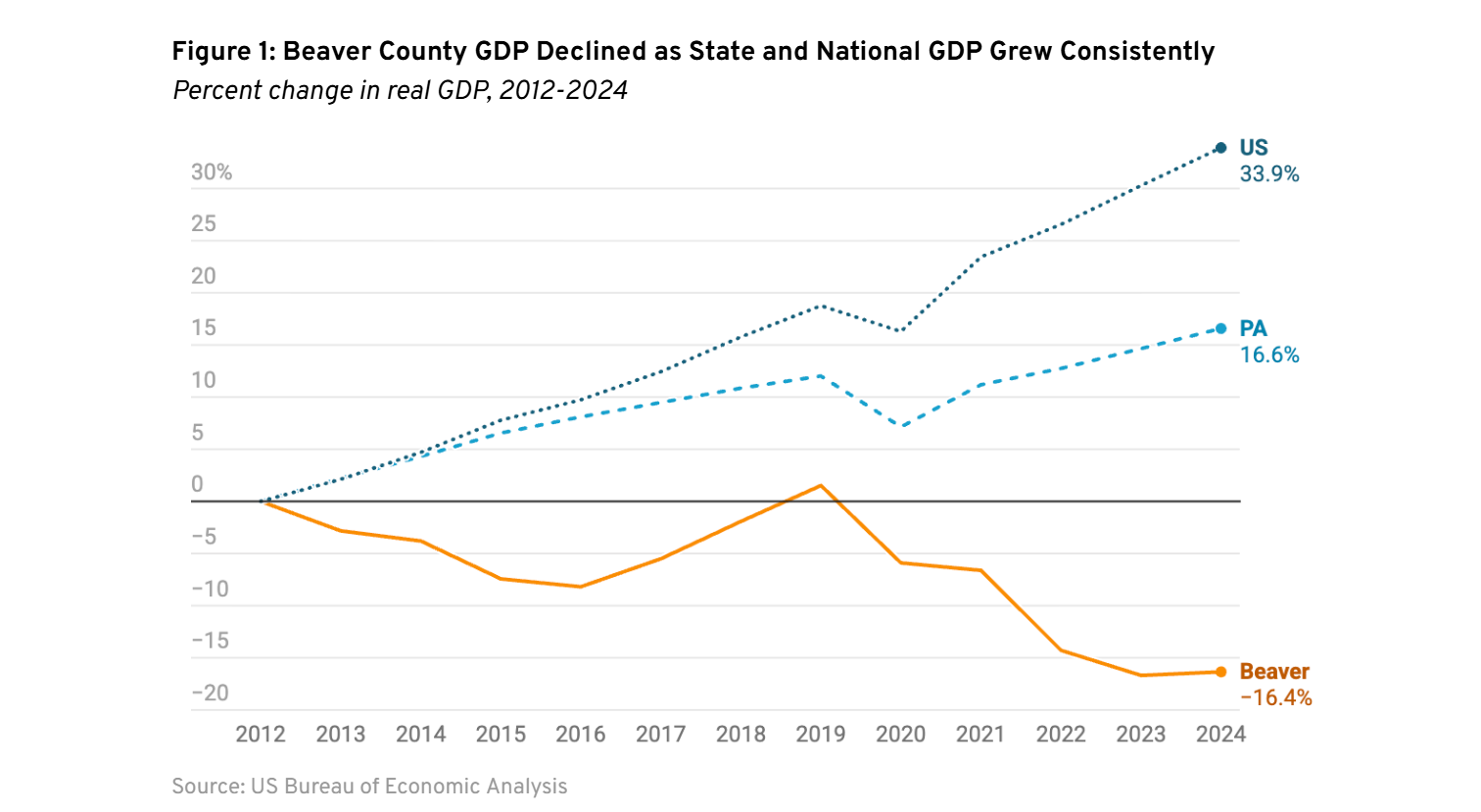
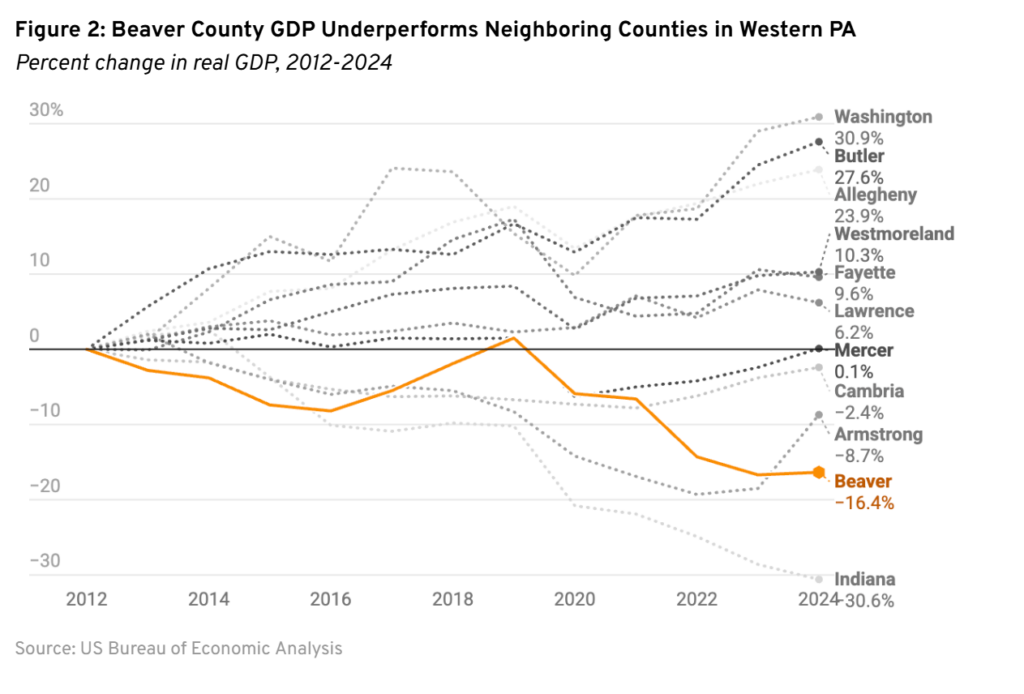
Between 2012 and 2024, GDP grew statewide and nationally, apart from a brief decline during 2020 as a result of the onset of the COVID-19 pandemic. Meanwhile over the same period, Beaver County GDP fell by more than 16%. While Beaver County experienced a brief period of GDP growth between 2017 and 2019, when the plant’s construction was in full swing, the county struggled economically during the pandemic and has still not recovered to the extent that the rest of the state and country has, despite the Shell facility’s startup in 2022.
This underwhelming performance seems to be unique to Beaver County. Federal data show that Beaver County’s GDP declined at a steeper rate than its neighboring counties, experiencing worse performance in GDP than all but one of 10 nearby counties.
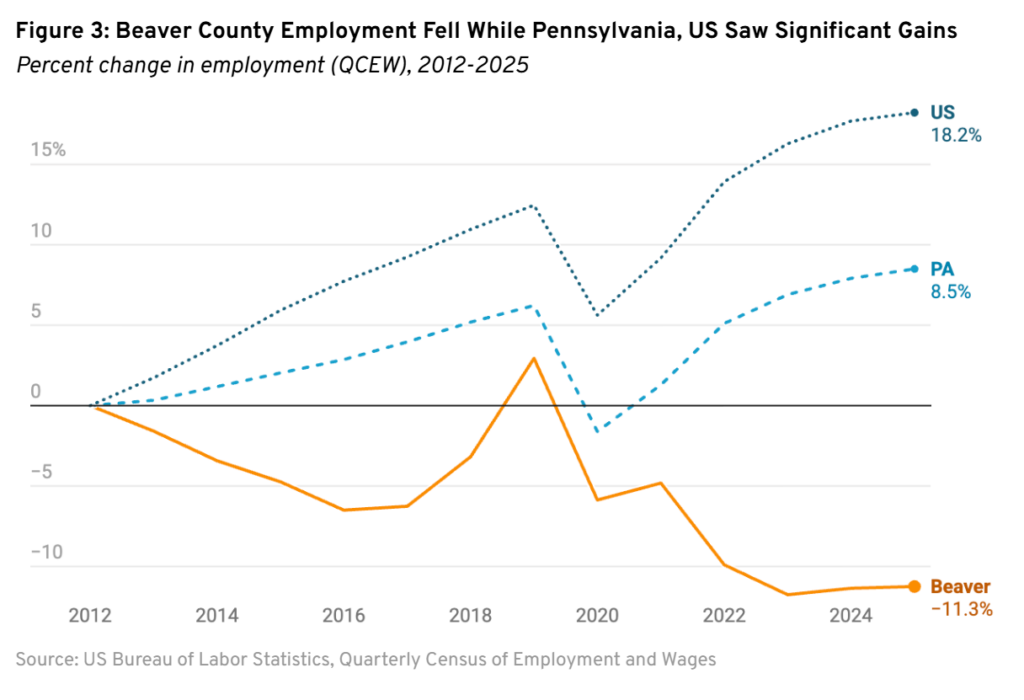
Job creation was one of the central selling points of Shell’s pitch to local politicians and state lawmakers. According to the Shell-commissioned RMU studies, the facility would create between 5,300 and 6,700 new direct, indirect, and induced jobs. In reality, the latest federal data shows that there are more than 6,000 fewer jobs in Beaver County today than there were in 2012. While Beaver County saw a 11.3% decline in the number of jobs, Pennsylvania and the US as a whole saw employment rise, by 8.5% and 18.2% respectively.
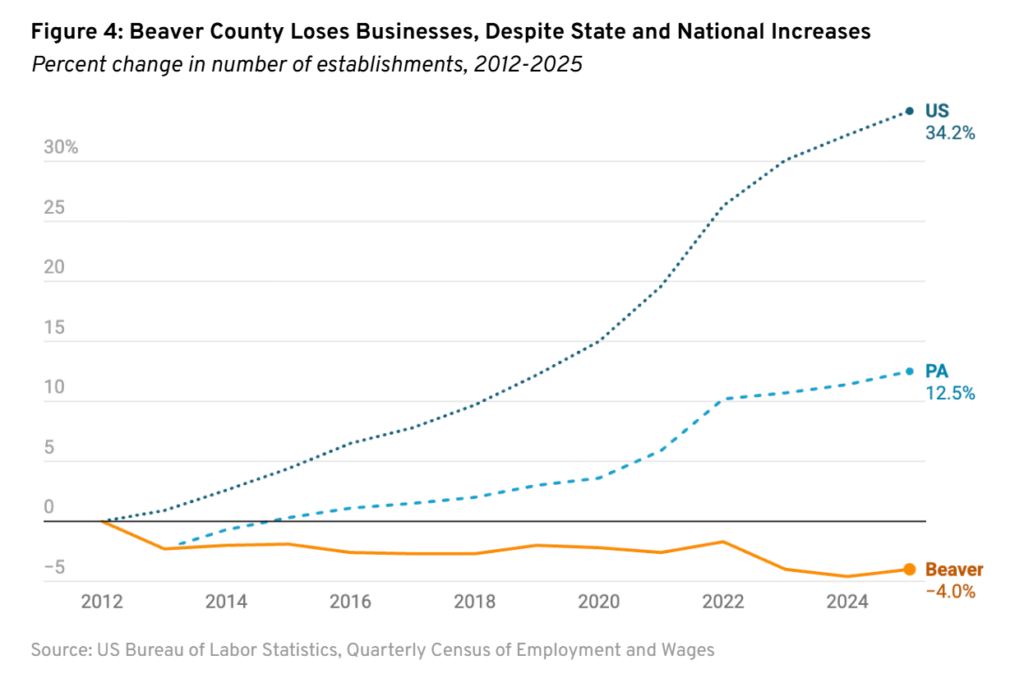
Likewise, Beaver County has fewer businesses today than it did when Shell first came to town, in contrast to growth at the state and national level. Shell and other boosters claimed that the petrochemical project would create an “economic windfall” marked by an influx of jobs and businesses generated as support industries. Instead, the number of business establishments actually declined by 4% in Beaver County between 2012 and 2025. Meanwhile, Pennsylvania and the rest of the US added business establishments, growing at a steep rate of 12.5% and 34.2% respectively.
Shell’s legacy in Beaver County should serve as a cautionary tale against the false promises of petrochemical development
In 2016, then-Governor Tom Wolf claimed the Shell project “promises positive economic ripple effects for years to come.” Unfortunately, those promises have turned out to be empty.
Making matters worse, Shell’s plant has also accrued a poor track record on environmental compliance. The facility has consistently violated air pollution limits and has exceeded permitted emissions levels of nitrogen oxides (NOx) in every single month since it began operating. State regulators have repeatedly fined Shell for discharging harmful chemicals into the Ohio River exceeding permitted limits. Now, Shell is seeking an updated Title V air quality permit to allow greater allowances for emissions releases and increased flaring of methane gas.
The Shell petrochemical debacle should be a cautionary tale for other communities that are considering whether to play host to petrochemical development projects. And for Beaver County too. As of this writing, a spate of proposals for gas-fired power plants and data centers has prompted a fresh round of promises of local economic renewal. But these promises don’t stand up to independent scrutiny and analysis either, and the cold facts from Shell’s experiment in Beaver County could be an invaluable lesson: state and local officials should take a long hard look at the oil and gas industry’s spotty record of broken promises before doubling down on a failed strategy.
Julia Stone is a writer and researcher focused on the intersection of climate, energy, and infrastructure development. Most recently, Julia has written about natural gas, petrochemicals, and data centers, and their impacts on Appalachia and the Pacific Northwest.
Eric de Place has 25 years of experience using research to drive change. His expertise on the energy industry, especially its economics and physical infrastructure, positions him to develop and lead strategies for a range of philanthropies and civil society organizations. He has helped design, launch, and direct numerous initiatives that bring accountability to the fossil fuel industry and speed the transition toward clean energy, including Bloomberg Philanthropies’ Beyond Petrochemicals campaign and the Ohio River Valley Institute.